Transactions pay the bills. Relationships build the business.

Transactions pay the bills. Relationships build the business.
Gaurav Midha, Stanislas Brunais & Jatin Kalra on loyalty, data, and what it actually takes to retain a GCC customer
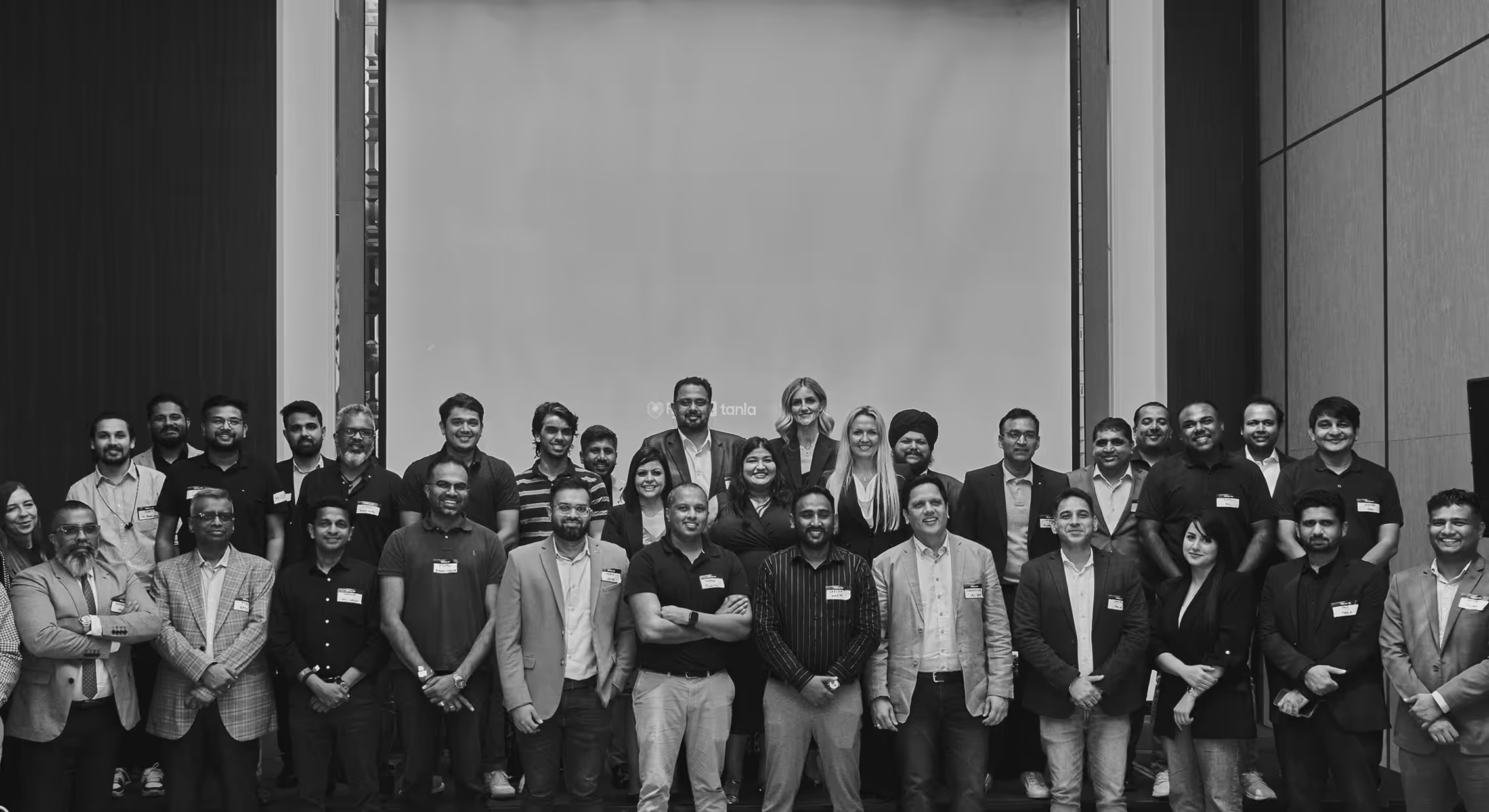
June 24, 2026 | Retail Re:Mix Dubai
The GCC has one of the most sophisticated customer bases in the world. Digitally native, spoiled for choice, and impossible to fool. At our latest Retail Re:Mix Dubai event, three of the region's most experienced retail leaders sat down to talk about what it actually takes to build real customer relationships in this market, not just drive repeat purchases, but earn genuine loyalty.
On the panel: Gaurav Midha, Chief Marketing Officer at Damas; Stanislas Brunais, Executive Marketing Director at Ounass; and Jatin Kalra, VP UAE at Apparel Group. Moderated by Arjun Kumar, Digital Growth Manager - Enterprise, Insider One
Here's what came out of it.
The playbook everyone's been running and why it's no longer enough
For years, the retail industry has operated on the same loop: attract, convert, repeat. It worked. Until it didn't.
"A lot of brands mistake frequency for engagement," Gaurav said early in the conversation. "We're always running after the next campaign, the next sale, the next conversion. But the real shift is from campaign-centric marketing to customer-centric journeys."
For a brand like Damas, where the average customer buys jewelry twice a year at most, this isn't just a philosophy, it's survival. "If you're only present at the moment they're buying, you're already part of their past. The question is how do you stay relevant in the six months in between?"
Jatin framed it differently, but landed in the same place. "What hasn't changed is simplicity. A consumer needs a shirt, a shirt is a shirt. What has changed is the shift from transaction to experience. If you're top of mind, you're there. If you're not, you miss the bus."
Stan added the expectation piece. "Customers now expect the experience to be seamless and frictionless from the very first interaction with the brand, whether that's a paid ad, an organic post, all the way to delivery and even a return. Five years ago they'd accept a slight delay. Now, you cannot afford to fail."
Loyalty programs vs. actual loyalty
This is where the conversation got sharp.
The GCC runs on loyalty programs. Everyone has multiple apps on their phone. But do the points actually build relationships?
Stan was direct: "Loyalty points is just a way of renting loyalty. You can be undercut by any competitor, and now that competitor doesn't even have to be GCC-based. They can target your customer from anywhere in the world."
His view: real loyalty comes from curation, deliberate action, and the experience you offer. Localized payment methods. Localized delivery. Personalization down to the box the product arrives in.
Jatin drew the line even more cleanly. "Most players don't have loyalty programs. They have incentive programs. Loyalty is what's left once the incentives disappear."
He pointed to airlines as the industry that's actually cracked it. "Do we fly Emirates for the miles? No. We fly it for the experience. The moment you arrive at the counter, your seat is set, your meal is chosen, everything is handled. That's trust. You're depending your life on that brand."
Gaurav brought in the emotional dimension specific to jewelry. "There's a lot of emotional loyalty in this category, people tie jewelry to specific moments in their lives. An engagement ring, a wedding, a first anniversary. That's a different kind of relationship to build and maintain, and you have to earn it."
Data: the fuel nobody's using well enough
"Data is the fuel," the moderator framed it simply. "But how many brands have actually cracked gathering and using the right information?"
Jatin spoke to the offline-online bridge. At Apparel Group, data flows across the entire value chain, store managers, associates, and online teams can all access what a customer has bought, how they've shopped, and what they're likely to need next. "The game changer today is anticipating demand. Knowing that this product at this store at this time is going to kick off, and betting on it."
He pointed to Amazon as the benchmark. "They know before you know what you wanted to buy." Noon's 15-minute delivery in the region came from the same logic.
Stan introduced a metric worth paying attention to: post-purchase silence. "I acquired one customer. It cost me seven times more than retaining one. But if they come once and never come back, that's a pure loss. The immediate next visit after someone's first purchase, that's the real sign of engagement."
Gaurav brought it back to the basics for smaller brands. Without first-party data, individual personalization isn't really achievable. But audience-level personalization is. "And you can't go silent. The moment we know someone bought an engagement ring, we know a wedding is coming. And after the wedding, a first anniversary. If you go generic at that moment, you've lost everything."
The GCC audience: diverse, but not as fragmented as you think
The region's mix of Emiratis, expats, and tourists could feel like a content and engagement nightmare. But the panelists pushed back on that framing.
"Cultural nuance is table stakes now," Gaurav said. "You have to get it right. But if I compare a young Emirati and a young Saudi, the mindsets are actually very similar, the expectations of authenticity, personalization, how you make them feel valued. The similarity is there."
For Damas, a brand with 120+ years of heritage, the challenge is making that tradition feel alive for a younger audience. "Heritage isn't a burden. It's the foundation. The role of the brand is to make that tradition relevant."
Stan went granular. Ounass doesn't segment by nationality, legally and strategically, that's not the move. Instead, they segment by behavior and interest: category cohorts, brand affinities, browsing patterns. Then they layer in cultural calendars.
"During Ramadan in Saudi, 60% of our traffic is between midnight and 4am. That's not the same in the UAE. So we adapt, content, timing, delivery, everything, down to the city level. A Riyadh customer and a Jeddah customer are not the same."
Jatin agreed. "Dubai behaves completely differently to Abu Dhabi, to Al Ain, to Sharjah. Within Dubai, Sheikh Zayed Road behaves differently to Discovery Gardens. It's about knowing your consumer, acting on them well, and predicting behavior, not just responding to history."
Physical stores aren't going anywhere. If anything, they're more important.
Jatin made a point that landed with the room. "Experience multiplies when a customer has been to your store and left happy. Physical stores make memories fresh. You want to go again."
In the GCC, mall culture is genuinely embedded in daily life. "People come here on weekends with their families. It's a stress breaker. It's social. That's not going away." He also noted that Apparel Group has 10 brands signed and waiting — and no retail space to put them in. "That's a good problem to have."
Stan added that Ounass has moved into physical commerce, not just as a one-off, but as something more permanent. "When you bring a new brand into the region, people expect to feel it, touch it, be introduced to it. There's no technology and no automation that will replicate that. Not even AR."
A double-digit percentage of Ounass's revenue already comes from personal shopping services. The human touch, Stan said, has always been present. It has to remain present.
Gaurav closed it with a story. A customer walked into a Damas store with a five-year-old daughter who quickly got agitated, nothing for a child to do in a jewelry store. A sales associate quietly took the daughter to the side, gave her a coloring book and sketch pens, and let her settle in. "That's something you simply cannot replicate online. The trust and empathy built in that moment, that's what stays with a customer."
The risk of over-automating
Stan was asked directly: is there a risk that brands over-automate and lose the human warmth that actually builds loyalty?
"Yes. There is a risk for sure. But it's a risk we try to mitigate."
The way Ounass approaches it: the beginning of a customer service interaction may be AI-handled, but the end is always human. Delivery drivers are trained to address customers by name. The note in the box mimics handwriting. "We try to bring the human touch at the delivery moment, the moment we unfortunately don't have online."
The consensus in the room: automation is a tool, not a replacement. The brands that will win are the ones who use it to free up their people to do the things only people can do.
The metric that matters most, and it's not revenue
The conversation closed on this: if you had to pick one metric you're proud of beyond revenue, what would it be?
Stan: Retention merged with customer satisfaction. "The higher the satisfaction, the higher the retention. They move together."
Jatin: Cross-brand customer journey across Apparel Group's 60+ brands. "We track how a customer moves through different life stages and shopping patterns, from Birkenstock to Asics to athleisure to evening wear to their kids. How well we hold onto that journey across our portfolio is what we measure."
Gaurav: Something entirely qualitative. “We always say, it doesn't matter if they're walking out with your bag. What matters is they're walking out with a smile on their face. That's the metric."
The takeaway?
The moderator summed up the session the way it deserved to be: "Transactions pay your bills. Relationships build businesses."
That's the direction the market is heading. The brands that figure out how to earn real loyalty, not rent it, not incentivize it, but genuinely earn it, are the ones who will own the next decade of GCC retail.
Re:Mix Reads