The trust economy: How luxury brands win by fighting for local relevance

What happens when a German heritage brand and a French fashion house both learn the same lesson?
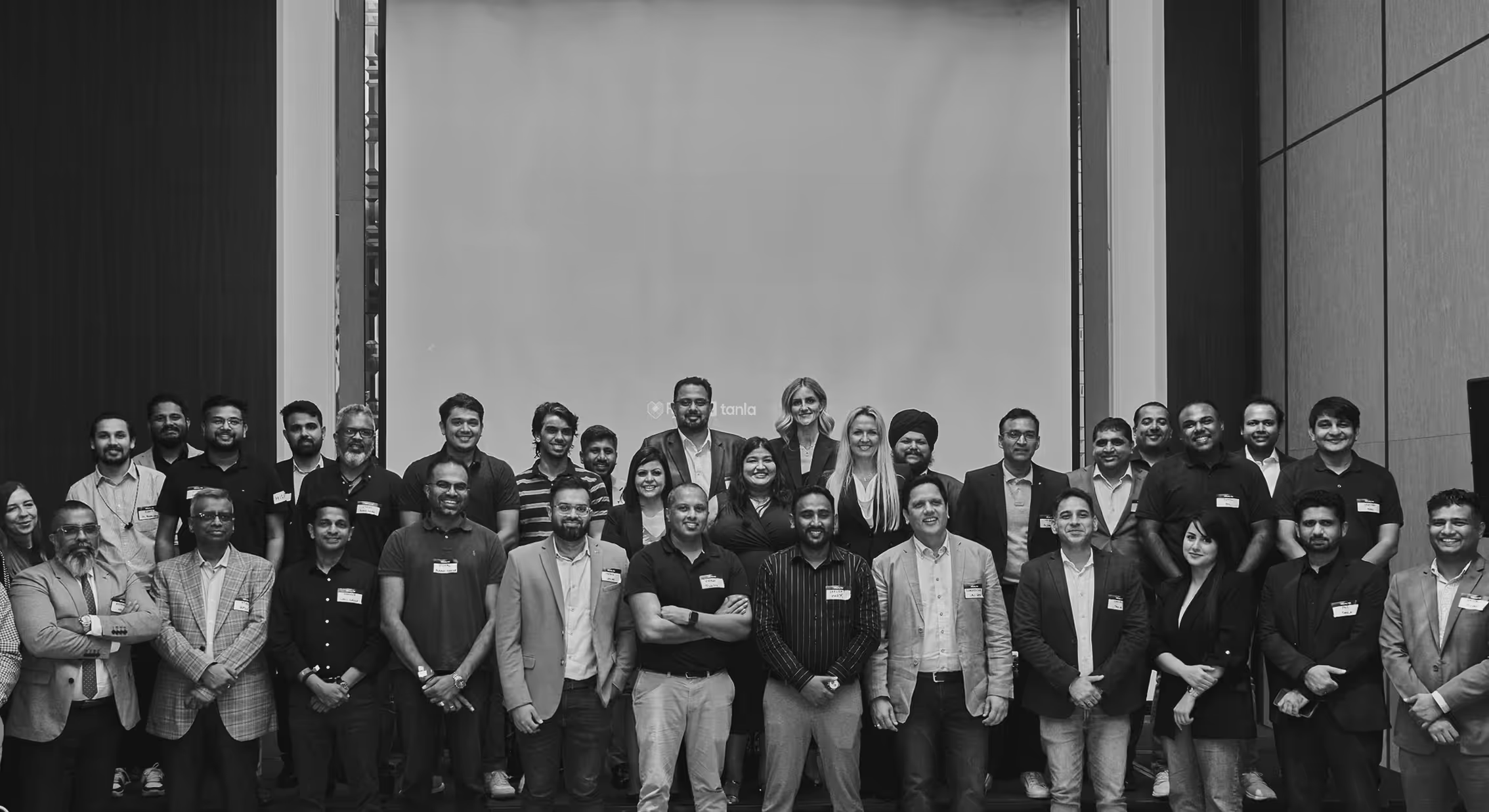
At Retail Re:Mix "The Luxe Edit" in Dubai, moderated by Giulio Dal Dosso, we sat down with two leaders navigating radically different positions in the luxury market: Alessandro Bovone (Senior Omnichannel Manager, HUGO BOSS) and Roger Rached (Head of Ecommerce, Christian Dior Couture).One represents premium accessible luxury. The other, ultra-luxury with €200K+ annual clients. Different price points. Different customer expectations. Different operational realities.But here's what stopped the room: both are fighting the exact same battle with their headquarters. And that battle isn't about technology—it's about trust.
The setup: two markets moving at wildly different speeds
Before we get into the fight, here's what's happening in the GCC luxury market that makes this conversation matter:The growth is absurd.
First half of 2025 numbers tell the story: UAE up 7%, Saudi Arabia up 57%, Bahrain up 30% after the Marassi mall opening. These aren't incremental gains—they're step-function changes. While Qatar flatlined at 2% post-World Cup and Kuwait dipped to -1%, the broader trend is undeniable: this region is on fire.E-commerce penetration in GCC fashion hit 15% in early 2025—among the highest globally. But here's the paradox: for ultra-luxury brands like Dior, e-commerce penetration sits at just 2-3%, even in mature markets.Why? Because until recently, the digital experience was broken.
The invisible problem: when luxury goes online too fast
Roger from Dior put it plainly: "We just stumbled onto e-commerce quickly in 2020, after COVID. The problem was it wasn't very client-centric."
Translation: luxury brands panicked during lockdowns, threw up websites, offered minimal catalogs, and wondered why customers with €10,000 average basket sizes weren't buying.Think about that for a second. You're used to walking into a Dior boutique where a sales associate knows your preferences, shows you the full collection, arranges private viewings. Then you go online and find... 30 products and a checkout button.
Clients literally thought it was a fake website.
Alessandro from HUGO BOSS described a different version of the same problem: "We were in a phase where physical retail expansion and distribution was the core. Then after COVID, e-commerce booming—but booming as a vertical."Everyone built e-commerce as a separate channel. Separate inventory. Separate customer data. Separate everything. And then they called it "omnichannel" because they had both a store and a website.
The real definition of omnichannel (and why lost brands get it wrong)
Alessandro's definition cut through all the buzzwords:"Omnichannel is more of a mindset. A company that still works in silos or still recognizes a channel P&L separated from another one will always have the friction to navigate a multichannel omnichannel behavior."
Here's the three-part framework he broke down:
1. Organization comes first. If your retail team and digital team have separate KPIs and are measured on separate P&Ls, you don't have omnichannel. You have internal competition. Technology can't fix structural dysfunction.
2. Experience is what you're actually selling. Once you set a standard with customers—say, seamless pickup, instant points, zero friction—that becomes the baseline expectation. You can't roll it back. "If a customer wants to have an experience with you by phone, it should be exactly the same as the one in a flagship."
3. Technology is just the enabler. Good technology that doesn't fit your organizational structure can't scale. Good technology that doesn't match your brand promise is the wrong technology.
This isn't theoretical. For HUGO BOSS, it meant connecting D2C e-commerce, concession models, franchise partners, store inventory, fulfillment, payments, and—most critically—customer data into one ecosystem.
For Dior, it meant integrating boutique inventory for ship-from-store, building client service that operates until 11 PM, offering same-day delivery with packaging that meets Dior's luxury standards, and creating seamless experiences for clients spending €50K-60K online.
The fight: why local teams have to prove themselves to HQ
Here's where both Alessandro and Roger said the same thing in different words: the biggest challenge isn't technology. It's convincing headquarters that local markets work differently.
Alessandro's version: "How do I convince a multi-billion dollar company investing in global templates that a relatively small market like the Middle East—highly profitable but not the biggest in contribution—how can we be credible by acting locally?"
Roger's version: "It's a constant fight between the local markets and the central teams. Obviously the objective is to maintain a universal image of the brand. So it's very complicated to localize from an image point of view."
The trust you have to earn
Both leaders described the same journey:
Step 1: Build local infrastructure that works. You can't ask for autonomy without proving execution. HUGO BOSS built a complete digital ecosystem in UAE first—OMS, WMS integrations, loyalty app, omnichannel tools for sales assistants—then used that as the foundation to scale regionally.
Step 2: Show results that HQ can't ignore. Speed to market. Flexibility. ROI optimization. When you deliver on promises faster than the global roadmap, you earn credibility.
Step 3: Use that trust to fight for local relevance. Once HQ trusts you, you can push for the adaptations that actually matter to customers.
The fights worth having: what local markets actually need
Payment methods (Roger's battle)
"Tamara is considered a natural payment method in the region. Centrally for Dior, it's a no-go because it degrades the image. Small, tiny topics like that could be huge discussion topics."
Cash on delivery? Critical in Saudi Arabia, even for ultra-luxury. In Europe, it doesn't exist. But in the GCC, if you don't offer it, you're eliminated from consideration.
These aren't minor UX tweaks. They're the difference between converting a sale and losing a customer.
Delivery speed (everyone's battle)
Roger: "In Europe, clients don't expect same-day delivery or within two to three hours. In UAE, if you don't do that, you're out of the game."
Same-day delivery for luxury goods isn't about logistics—it's about meeting expectations set by every other brand the customer interacted with that day. Your competition isn't other luxury brands. It's the last seamless experience they had, whether that was food delivery or electronics.
Dior executes this with mystery shoppers weekly, delivery quality reports, and packaging that maintains luxury standards even at speed. It's operationally complex. But it's non-negotiable.
Localized storytelling (the unsolved problem)
Roger flagged this as a future priority: "We would like to find a better way to create localized storytelling for big moments. Big moments are where we do a big chunk of our revenue."Ramadan. Eid. Regional celebrations. These aren't minor calendar events—they're peak revenue periods. But global luxury brands are extremely cautious about how they localize messaging. Brand integrity vs. cultural relevance. It's a tightrope.
The infrastructure play: Why UAE became the testing ground
Alessandro explained why HUGO BOSS is betting on UAE as the foundation for regional and global expansion:
"We're trying to build in the UAE an ecosystem that is extremely scalable and modular to additional countries and business models."
Here's the logic: Dubai can serve as a logistics and digital hub for North Africa, Southern Africa, India, Russia, and beyond. But only if the technology stack is modular enough to plug into different business models—D2C, concession, franchise, marketplace.
The criteria isn't "which market should we enter next." It's "how scalable is the foundation we're building."If you nail the infrastructure in one market, you can deploy it globally in weeks instead of quarters. That's the competitive edge.
The partnership equation: Why brands can't do this alone
Both leaders credited local partners as the unlock for gaining HQ trust.
Alessandro on working with Fynd: "Without a local partner or strong, credible partner, the trust that we built with the headquarter was definitely impossible. We found the capability to support us in the design phase, strategic phase, building a roadmap together, and then implementation and maintenance."
Why does this matter? Because global luxury brands are experts in product, clients, and people. They're not experts in the specific payment gateways, logistics partners, regulatory nuances, and consumer behaviors of emerging markets.Local partners who know the market better than you, who are willing to co-create, who can move fast—they're the difference between a global template that flops and a local solution that scales.
HUGO BOSS's partnership with Fynd enabled them to launch their first UAE platform, move into omnichannel in-store solutions, and integrate with global CRM and loyalty systems—all with release roadmaps every two to three weeks instead of waiting months for global updates.
The human component nobody talks about
Roger flagged something that often gets buried under technology discussions: the human resistance to change."We're integrating a digital ecosystem and trying to convert people who operate in stores. The only way to do it when you're nascent as a platform is ship from store. So what do we get? Resistance."
You're asking boutique directors and sales associates to fulfill online orders using inventory they see as "theirs." You're changing their KPIs. You're asking them to adopt new SOPs.Technology is the easy part. Change management is where most digital transformations die.Dior's solution: Align incentives. Rethink KPIs across channels. Train teams on the omnichannel mindset. Make sure the human process works before you scale the digital one.Alessandro echoed this: "Experience at the end is at the core of what we promise to the end customer. Technology is just the enabler."
What's next: The AI question everyone's avoiding (until now)
Giulio waited 10 questions before asking about AI. And both leaders laughed at the timing.Alessandro: "I believe we tick the box for organizational omnichannel, for experiential omnichannel. But right now we're still in an infrastructural phase. Until you effectively integrate customer data, multi-geographical consumer tracking, and business model reconciliation—we're not ready for AI to deliver its full value.
"His bet on AI isn't chatbots or generative content. It's invisible retail—forecasting, planning, budgeting, reconciliation across B2B, B2C, concessions, franchises, marketplaces. "That's where I would expect AI to come to help us. We need to be ready."
Roger's focus is more immediate but equally challenging:Personalization at scale. How do you replicate the boutique experience—where a sales associate knows your preferences, curates recommendations, follows up after purchases—for tens of thousands of e-commerce clients? AI-powered CRM automation, predictive recommendations, dynamic merchandising.The generative AI fight. Tools exist today that can localize creatives, adapt storytelling, generate region-specific content. But luxury brands have "very high scrutiny on what they vehicle as messages." How do you maintain brand integrity while using generative AI? Still unsolved.
Client-telling AI. Roger put it clearly: "It's easy to say when you do it for 10 clients, 15 clients when you have sales associates in boutiques managing 50 clients. But how do you do it when you have tens of thousands of clients with different types of purchases and not enough people to do it?"
Both agreed: AI has massive potential, but only if the data infrastructure is solid first. Bad data in, bad AI out.
The ultra-luxury difference: When clients spend €200K annually
Roger shared insights that reveal just how different the ultra-luxury segment operates:"We have clients who buy above 20K Euro per year. And then we go up to about 200K, 300K per year. These people really require personalized sales associates. So we allocate them specific SAs, even if their boutique main boutique is e-commerce."At this tier, expectations are:
- Weekend services (even though it's not eco-friendly at volume)
- Ability to exchange or modify orders immediately
- Client service available until 11 PM
- Customized invitations to in-boutique shows and specific collection presentations
- Personalized wish lists sent directly to them
These aren't perks. They're minimum expectations. And the region demands even more than mature markets.Roger's observation from his previous experience: "I came from mass FMCG. I worked at L'Oréal before, so for me it was a shock."
The uncomfortable truths
1. Global templates don't work in high-growth markets
Alessandro: "How dynamic is this market, how fast it's moving. If you do not have strong leadership in the market, how can you even imagine you could put in place certain strategies that could make an impact? It's absolutely impossible."You can't run the Middle East from Munich or Paris with quarterly release cycles. The market moves too fast.
2. Luxury brands can't hide behind "but we're different"
E-commerce penetration in GCC fashion is 15%—among the highest globally. Healthcare and pharma are setting digital benchmarks. Traditional sectors built on physical presence are moving faster than luxury in some cases.Nobody gets to hide behind "our industry is different" anymore.
3. Operations Are the New Differentiation
Both leaders kept returning to this: the magic isn't in having the best technology. It's in making the technology invisible so customers only experience ease.
Predictive inventory, optimized routes, seamless fulfillment, instant rewards, unified customer data—none of it should be visible. It should just work.Roger: "The backbone of digital is operations. We can talk from now until the end of days about the importance of e-commerce, but at the end of the day, people are very sensitive to how you incentivize them and how you approach them."
The Broader Pattern: What This Means Beyond Luxury
Strip away the €50K handbags and the mystery shoppers, and here's the universal lesson:Markets that are growing fast demand local decision-making. Global roadmaps can't keep up. Brands that empower regional teams with autonomy, resources, and trust win. Brands that force local markets to wait for global templates lose.
Customer expectations are set by the best experience they had today, not by competitors in your category. Dior isn't competing with Chanel on delivery speed. They're competing with the food delivery app that showed up in 30 minutes.Technology without trust is worthless. You can have the best tech stack in the world, but if your HQ doesn't trust your local team to execute, it doesn't matter. Trust is the unlock.Partnerships aren't optional. Brands that try to build everything in-house move slower, make more mistakes, and miss windows of opportunity. Local partners who know the market, move fast, and co-create are the competitive advantage.
The Bottom Line
At Retail Re:Mix "The Luxe Edit" in Dubai, moderated by Giulio Dal Dosso and featuring insights from Alessandro Bovone (HUGO BOSS) and Roger Rached (Christian Dior), the conversation revealed something most industry panels miss:The future of luxury retail isn't about choosing between global consistency and local relevance. It's about building the trust and infrastructure to do both.
HUGO BOSS is building modular systems in UAE that can scale to 50+ countries. Dior is fighting for payment methods and delivery speeds that preserve ultra-luxury standards while meeting regional expectations. Both are navigating the same tension: how do you maintain a global brand while moving fast in local markets?
The winners aren't the ones with the biggest budgets or the fanciest technology. They're the ones who earn trust with headquarters, fight for what local customers actually need, and build infrastructure that makes complexity invisible.Saudi Arabia is growing 57% year-over-year. E-commerce penetration is hitting 15%. Customer expectations are rising faster than brands can adapt.
The question isn't whether you'll need to localize. It's whether you'll have the trust to do it before someone else does.
Re:Mix Reads