Cross-border commerce: Scaling e-commerce from the world to the Middle East

Cross-border Commerce: Scaling E-commerce from the world to the Middle East
February 2026
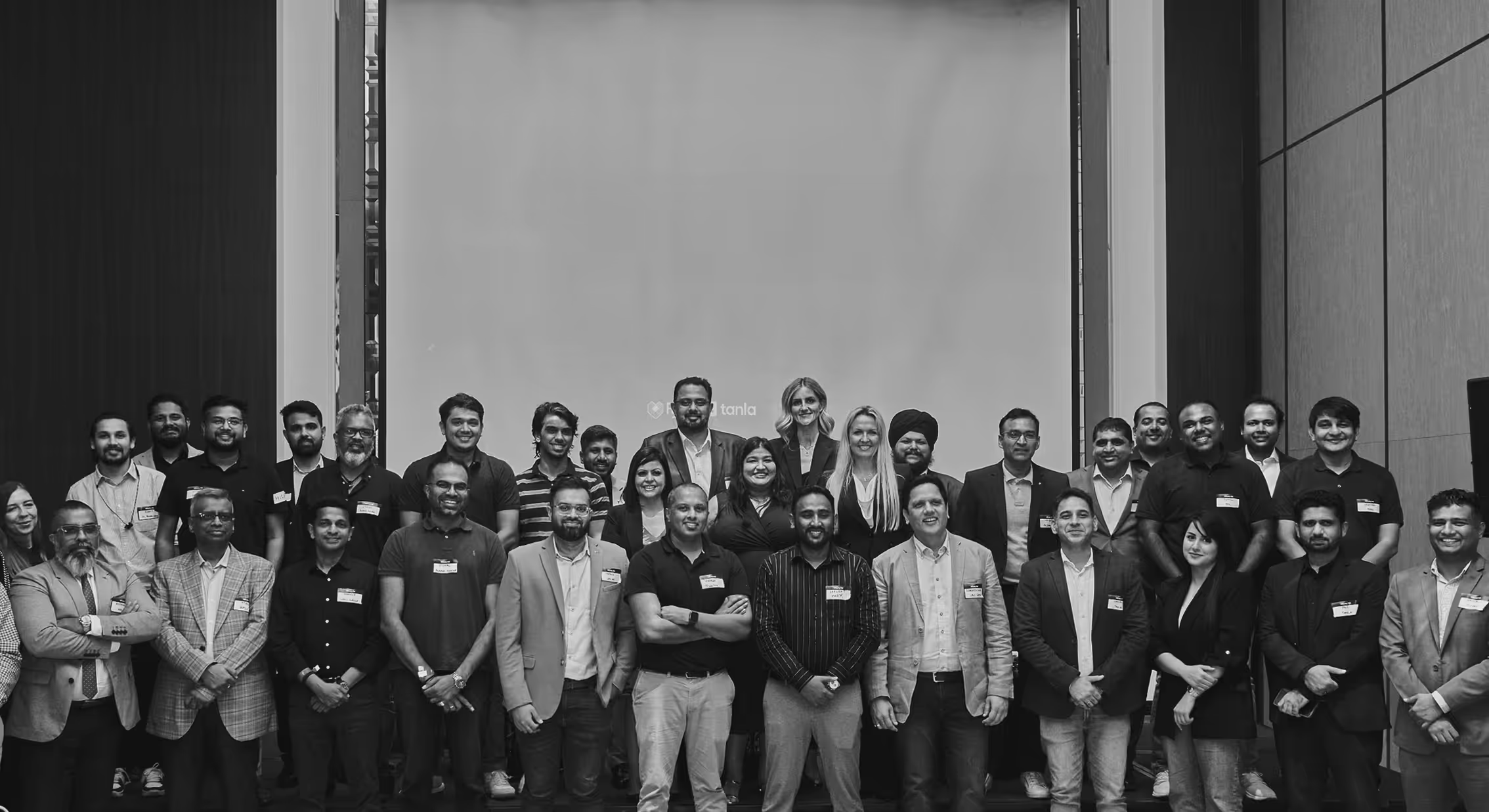
From the Retail Re:Mix panel discussion moderated by Khaled Boudemagh, Head of Strategic Partnerships, Checkout.com, featuring Sara Ahmed, Chief Technology Officer at The Petshop, and Abhinav Patwa, Executive Vice President at Zed Mobility from Al Ghurair Group.
When brands say "Let's go and conquer the Middle East"
Khaled Boudemagh opened the evening with a straightforward frame: Cross-border commerce in the Middle East means what it really takes for global brands to enter the region: localize fast, keep conversion high, and remove friction across tech, operations, payments, and customer experience.Then he asked the question that matters: “when brands say they want to enter the Middle East, what do they usually underestimate the most?”
Sara Ahmed from The Petshop cut straight to it. The Middle East is looked at as a growth market, and brands underestimate that even though it's growing, the expectations here are quite global. Customers still have global expectations when it comes to their on-site experience, their delivery experience, their payment experience. "They're always comparing you to global brands like Amazon to international luxury brands."
The punch line? Customers are now exposed internationally. So it's not really a maturing market in terms of expectations. Translation: if you thought "emerging market" meant you could show up with less-than-perfect execution, you're already behind.
The homogeneous market trap
Abhinav Patwa from Zed Mobility added a second layer. One of the things often underestimated is that the Middle East is thought of as a single homogeneous market, whereas it's actually very, very heterogeneous.He got specific. Every single country is different in the Middle East. Every city within that country could be very different, in fact within cities.
How granular? Abhinav's business is hyper-local in Dubai, and they've discovered that Deira and Marina have very different behaviors from each other. It becomes as heterogeneous as that.Khaled summarized it: so in short, in the Middle East we are as much demanding as other Western more developed countries, and brands should know that. And secondly, they have to know the difference between Dubai Marina and Deira.Abhinav's response? Pretty much.
What to localize vs. what stays global
The next question got operational: what must be localized versus what can stay global?Abhinav laid out the framework. There are certain things where there's an experience benchmark, tried and tested things that work. Payments, for instance, have a global standard in terms of how they work. It's pretty much the standard mechanism that works, so you don't necessarily need to localize it.But then there are experiences which are on the ground. Both their businesses have delivery components which require a lot of localization because there are nuances local to the market. "Everything which is operationally heavy, requires localization."
Things which are not necessarily operationally heavy and where there are global benchmarks already set can stay global.Sara brought it to life with examples. Every market has nuances in terms of how aggressive your delivery promise can or should be. There are markets where people expect deliveries in minutes, particularly for retail and online e-commerce. You're competing in certain areas where delivery comes in minutes. And in some locations and geographies, customers are completely fine with a couple of days of delivery.
On payment methods, credit cards work, but you see variances in terms of adoption. So you need to optimize your experience and journey online depending on the regions. Some prefer wallets like Apple Pay or typical credit cards. Some rely heavily on local payment methods like Mada in Saudi or similar methods in Kuwait.
And on communication, offsite communication after the order happens matters. What language you speak to the customer, localizing that is important. But Sara added an interesting nuance: localizing the language isn't as critical as it used to be. "There's a very broad language awareness of the English language, just not over localizing with dialects, which is something we've seen some of the platforms over complicate their translation services." It's about finding the right balance.
What should stay global
When Khaled pushed on what should remain consistent across markets, Sara was clear: customer experiences, meaning your on-site purchase journey. There are typical standard experiences that customers expect the same everywhere.
She warned against overcomplication. You don't want to build really complex or over-complicate certain things in their journey. Especially for e-commerce and online, it stays pretty much the same. There's no need to over-engineer that.The summary? Mostly the localization happens in operational parts: in payments, in deliveries, and the experience post-purchase. This is where localization is absolutely important. "And localization here means picking the right method more, than language or aesthetic localization."
The quick commerce reality
Khaled shared a personal observation that captured the speed expectations in Dubai. Coming from France, where everything stops at 7-8pm and Sunday is completely off, Dubai operates almost 24/7 with near-instant delivery. He joked that global brands might think customers here would be ready to wait one month and maybe the delivery will come on the back of a camel.Sara and Abhinav's response: that's the opposite. Total opposite. We're very much advanced on that and very proud of it.
Technology infrastructure: What needs to be in place
When the conversation shifted to technology, data, and systems, Sara outlined the requirements. What needs to be in place is a cohesive system. Taking into account the nuances of different geographies and regions means you need a system that can serve multiple regions efficiently and reliably.She emphasized accountability. One of the things that is unforgiving in this region: whatever you promise the customer, you need to deliver. So if you can deliver in minutes, promise minutes. If you can't, then promise hours or days. "Transparency and reliability is important." Because that is your ultimate objective, and that's where customers hold you accountable. The system needs to enable you to do that.The operational requirements include reliable payments that don't fail, delivery providers that don't fail you, delivery routing that chooses the right provider to fulfill your promise. Intelligence systems, especially if you're doing cross-country operations, need to allow you to scale operations dynamically based on which country you're working in.
The customer forgiveness question
Khaled pivoted to an interesting angle: what are customers in the Middle East less forgiving about?Abhinav used a relationship analogy. While the Middle East is an attractive market, it's actually not a massive market from a population perspective. There are enough companies already present. "So if I were to draw a human relationship example, everybody has already dated somebody." So if you're now going out to date somebody, there are already benchmarks in place, and you need to prove yourself for that person.
In business terms, customers have a bare minimum threshold of the hygiene experience across all elements: delivery, payments, customer experience. And they are unforgiving if you're not meeting that.But he added an important caveat. That doesn't mean you'll never go wrong. Let's be practical. There are times where things won't happen based on what you promised. "What is very important is that is there human systems in place to be able to acknowledge that, yes, we goofed up, we did not deliver on what we said and therefore here's an apology, here's what we are doing." Building that trust that things will go wrong occasionally, but you'll make it right.
Offers vs. reliability
When Khaled brought up brands like Kita and Temu that use offers and gamification to attract customers, Sara made a critical distinction. An offer can make you try a service, but not necessarily make you stay. "So that's the key differentiator that can get you into the road. But if you have to stay, then you need to provide that consistent experience which is reliable." Offers can only take you so far.She framed it with a scenario. If you're in a hurry and need an order in one hour, will you order from the brand that's broken promises before but is offering discounts, or will you open the app you trust to deliver on time? When you need convenience and it's not a luxury, you'll always go to the brand that is reliable.
Local talent: The steering wheel analogy
As the panel moved toward closing, Khaled asked about local talent and decision-making. How critical are local talents to scaling a successful business for global brands in the Middle East?Abhinav had an analogy ready. If you want somebody to be responsible for driving a car, you need to give them control of the steering wheel. "So you can't have local teams not having control but being responsible for the business." If you're responsible for driving the car, the steering, the throttle, the brake have to be accessible.His prescription: you need to have a local team which is responsible for running the business. But they are the closest to the ground. So it's important to empower them to be able to drive and do what is required to scale the business and have the trust in them doing that.
Cultural awareness isn't optional
Sara illustrated this with Mumzworld's expansion into Saudi. Mumzworld is a brand they started in the UAE some time ago. When they started operations in Saudi, it was run by the team in the UAE.The result? That was a bottleneck in terms of decision making, understanding of the brand, and certain quick decisions that needed to be made.Everything changed when they made a shift. "Things only started to really grow significantly when we had key team members in Saudi who had full ownership, full responsibility, full control and HQ mainly has visibility, has guidance, has strategy.
"The operating model: execution, operations, and permission to take action moves much faster when you have local people on the ground. Local people who even speak the native language and understand the jokes that people speak. "It's important for the branding, the marketing part, the dialect part, and operationally the on the ground, they know the nuances of the place.
"Khaled summarized the tradeoff: there's a trade-off between speed and control, and between having the capabilities to speak the local language and the capabilities to take decisions while understanding the global branding guidelines.
Key takeaways: No universal playbook
As the panel wrapped, Sara delivered the most important lesson. Go back to the point Abhinav started with: "There's no playbook really per country that if you apply it in Europe, it will come and you apply it successfully here, or if it applies in India, you come and successfully apply here."The reality? There are differences per market, per city even. And that's something brands need to do enough research about before entering, especially on customer expectations because the expectations are very different here. It's just the nature of any market. It's specific to that market.
The regulatory surprise
Abhinav added one final critical point that often gets overlooked. Unlike many other parts of the world where regulations are generally lower, in this part of the world, the regulations, especially in some sectors, can be very high.He got specific. So if you come in thinking you'll be able to do anything in an unregulated manner, that's not necessarily the case. Regulatory guidelines are very high. For instance, in their business there's a regulator which governs multiple aspects, including implications on data.
The often-overlooked requirement: almost all countries have very strict data localization norms. That's something which often companies don't consider. And they were talking about this before the session, that often that is something which is overlooked by people when they are entering the market.His closing advice: what's important is to understand the market, to research and to learn for the industry specific.
What this means for cross-border commerce
At Retail Re:Mix, Khaled Boudemagh (Checkout.com), Sara Ahmed (The Petshop), and Abhinav Patwa (Zed Mobility) made clear that succeeding in Middle East e-commerce requires more than ambition. It requires deep understanding.Customer expectations are global from day one.
Growth market doesn't mean forgiving customers. They're comparing you to Amazon, to luxury brands, to the best experience they've had anywhere.
The Middle East isn't one market. It's heterogeneous down to the neighborhood level. Deira and Marina within Dubai behave differently. One regional strategy won't work.Localize operations, not experiences. Keep the purchase journey standard. Localize payment methods, delivery speeds, communication, and post-purchase experiences. Don't overcomplicate with excessive dialect translation.Reliability beats offers. Discounts and gamification can get customers to try you, but only consistent, reliable execution makes them stay.
Local teams need control, not just responsibility. You can't hold teams accountable for business outcomes without giving them decision-making authority. HQ provides visibility, guidance, strategy. Local teams execute.Cultural awareness drives speed. Teams that understand the dialect, the jokes, the nuances can move faster on branding, marketing, and operations.
There is no universal playbook. What worked in Europe won't work here. What worked in India won't work here. Every market demands specific research, especially on customer expectations.Regulations are strict, especially on data. Unlike many other markets, Middle East countries have very high regulatory standards and strict data localization requirements. This gets overlooked and causes problems.
The opportunity in Middle East e-commerce is real. But success isn't about bringing your proven playbook from another region. It's about doing the work to understand each specific market, empowering local teams to execute, and building systems reliable enough to deliver on every promise you make.
Because in the end, customers here aren't less demanding. They're exactly as demanding as they should be. And brands that understand that are the ones that win.
Re:Mix Reads