Acquisition gets you customers. Retention builds a business.

Acquisition gets you customers. Retention builds a business.
Sabrina Würfel, Jennifer Cohen Solal & Bappaditya Banerjee on loyalty, community, and what keeps a customer coming back
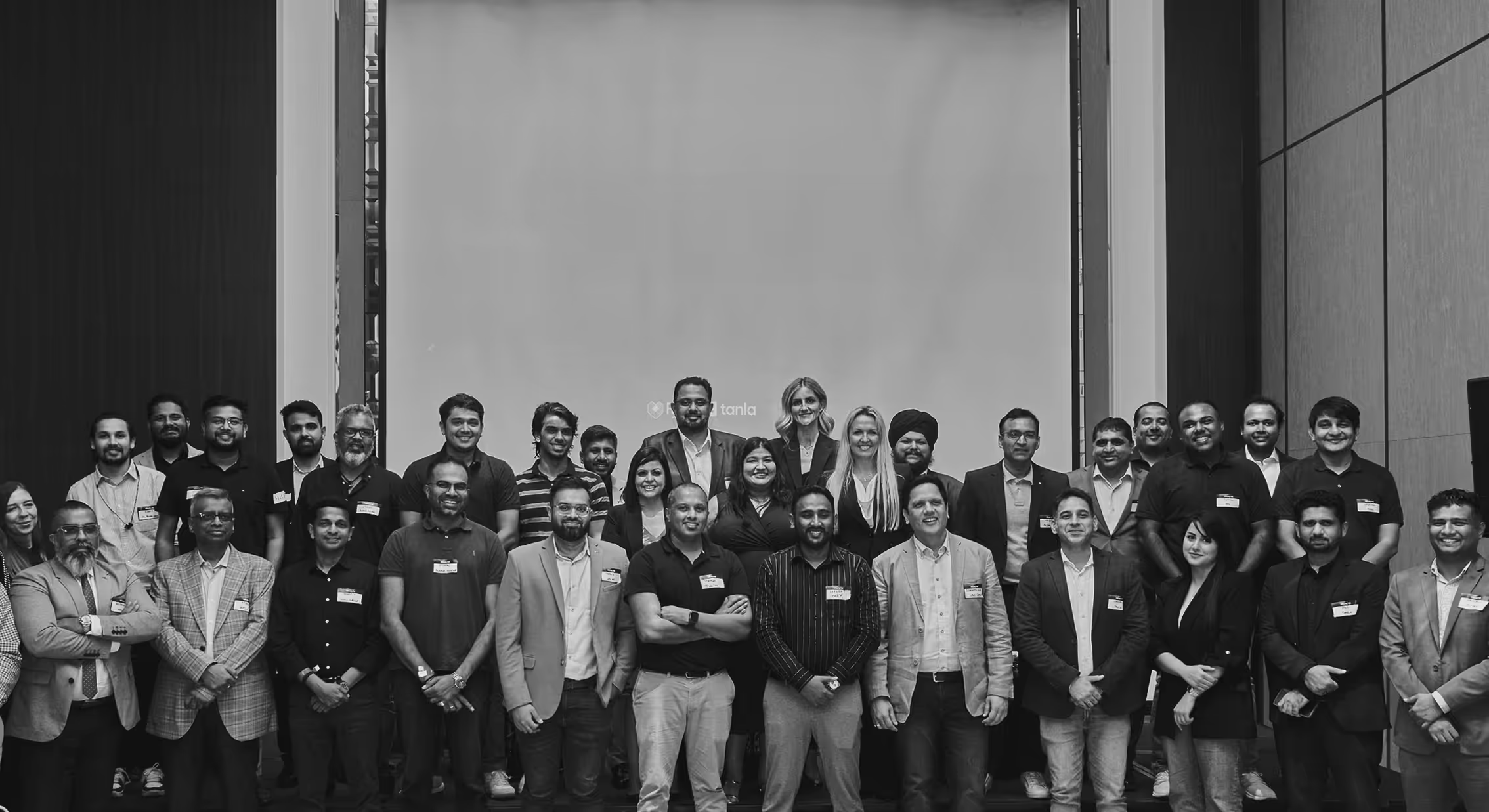
June 24, 2026 | Retail Re:Mix Dubai
Three leaders. Three completely different businesses. One question that every brand in the GCC is losing sleep over: once you've got the customer, how do you actually keep them?
At Retail Re:Mix Dubai, Sabrina Würfel, Head of Direct to Consumer Business at Samsung Gulf Electronics; Jennifer Cohen Solal, Co-Founder & CEO of HushDay; and Bappaditya Banerjee, Director of Technology at BFL (Brands for Less) Group, sat down for a conversation that covered everything from smart fridges to WhatsApp groups to a CEO who built a loyalty platform on Claude in two weeks and got a 60% discount on his existing contract.
Moderated by Dharmendra Mehta, Managing Director MEA at Fynd.
Here's what came out of it.
Loyalty programs vs. actual loyalty, again
The conversation opened where it had to: on the gap between what brands call loyalty and what loyalty actually is.
Sabrina put it plainly early on. "Points are not loyalty. It's an incentive. Loyalty is an outcome." For Samsung, the first signal of real retention isn't whether someone redeems points, it's whether they connected their device to the internet. Their fridge. Their washing machine. Their TV. "If you connect to our ecosystem and you're using our SmartThings app, we already know things about you that no purchase history can tell us."
Her example: she lives with one dog. Her washing machine settings are entirely different from a family of four. "When you look at how I engage with the app, you'll know I'm more likely to be a customer for the vacuum with a dog mode than someone else in our dataset." Retention, in Samsung's world, starts not at repurchase but at product activation.
Jennifer had a different vantage point entirely. HushDay doesn't have the Samsung ecosystem to fall back on. What it has is exclusivity. "From day one, we are not chasing customers. We are building a community. That's a very different marketing approach."
And Bapa, speaking for BFL Group, drew the line that the whole room seemed to agree with. "Loyalty as it exists in this region is very, very transactional. It's just incentivization. It doesn't create retention and engagement." BFL's own loyalty program, Smile More, had started the same way, and they'd had to consciously move away from pure points to something more behavioral and experiential.
Three completely different playbooks
What made this conversation work was how different the three businesses are, and how different their approaches had to be.
Samsung's approach: the ecosystem lock-in
For a brand where someone might buy a washing machine once every five years, waiting for the purchase to trigger retention is already too late. Samsung's play is the ecosystem. Connect your devices, use the apps, share your behavior, and Samsung can start to understand who you are well before you're back in market.
Sabrina also flagged something that's easy to miss: the UAE and Saudi are not the same market for this strategy. "In Saudi, there's a higher percentage of local community. If we lock someone in early — first phone, first watch, whatever, they're very likely not to switch. In the UAE, people come and go. You might stay three years, buy one washing machine, and the next one you buy in the UK." Knowing who's staying is a strategy in itself.
HushDay's approach: sell access, not price
Jennifer's two levers for growth are brand desirability and referral. That's it. "Strong brands attract customers. And the winning moment isn't when a customer comes back, it's when they bring someone else."
What's counterintuitive about HushDay's model is the basket size. This is a members-only off-price platform selling luxury goods at 60-80% off. You'd expect price-sensitive, low-spending behavior. Instead, the average basket is around Dh1,000, and during an evening dress private sale, the top spender dropped Dh70,000 in a single order. "We don't sell price. We don't even sell products. We sell access. People want to know a secret others don't."
From zero to 40,000 members in a few months, built on organic community, referrals, and events where show rate and spend both outperform paid acquisition every single time.
BFL's approach: the treasure hunt
BFL is a different animal. Off-price retail, store-centric, part of the same global group as TK Maxx and Burlington. And they've built a metric that you don't often hear in e-commerce conversations: time spent in-store during the treasure hunt.
"If somebody comes and leaves in two minutes, that's not success," Bapa said. "Customers don't come with a category in mind. They come to explore. And the thrill of getting a great deal,. six out of ten times you find something. The other four you don't, and you go to other stores. Our job is to make sure that four doesn't happen."
BFL's internal scoring framework, BFPQ, Brand, Fashionability, Price, Quality, is assigned to every product they buy. Not every product has the same score. In womenswear, brand DNA matters more. In menswear, quality wins. Category by category, community by community, the same product can be the right or wrong buy depending on who's in the room.
They've also mapped their customer base demographically and found something that complicates simple targeting: Indians are their highest-registered customer group. Arab expats spend 60% more per order. "The question is where do you go, volume or value, or do you do both?" Their answer is both, with different campaigns for different cohorts, all tied back to one core KPI: lifetime value.
The data that actually moves the needle
Jennifer's tech philosophy is simple and worth stealing: you don't need a heavy stack. A good CRM (she uses Klaviyo) and one unique source of data is enough. Then she feeds it to AI, Claude, ChatGPT, whatever's in front of her. "I tell it what I have. I ask what it thinks. It analyzes everything, what was the best lever, where should the budget go."
What she learned from this: organic Instagram community, not paid audiences, not influencer campaigns, has the highest show rate at events and the highest spend per visit. "So we shifted the budget accordingly. Event after event, private sale after private sale, we learn more."
Bapa's tech stack is more enterprise: BigQuery for first and third-party data, CRM tools for execution, and a full Customer Data Platform evaluation underway. But the principle is the same as Jennifer's, tie every technology decision to a KPI, or don't build it. "If it doesn't move lifetime value, average basket, or retention, it's not a priority."
His most memorable example: BFL's CEO built an entire loyalty dashboard using Claude over two weeks on his own laptop, one that did more than their existing paid solution. "We showed it to our loyalty solution provider. We got a 60% discount on the next subscription." It's quite ironic, as the moderator pointed out, that a loyalty company had to discount 60% to retain its own customer.
AI: quick takes, no hype
The panel closed on AI, and the three answers were genuinely different.
Sabrina: "You can't ignore it. We use it for personalization, for double-checking our own thinking. There are internal jokes about checking with AI before certain people ask you a question, because they'll cross-check you against it anyway. Don't worry too much that everything changes tomorrow. But if you don't know how to use it, you'll lose, personally, professionally, and as a company."
Jennifer: "Master AI or be replaced. It's basic. I prefer to be the one who masterizes it. The challenge as a CEO is the balance, we want employees to use it, but sometimes they stop thinking. They delegate completely. And AI cannot replace instinct. But here's the thing: instinct doesn't exist. What you think is instinct is just experience. That feeling, is this brand hot enough? Is this project right for this market? You can't replace that. Keep your critical point of view. Use AI to empower it." She also made the point that building HushDay today with AI took five people and six months. Without it, ten years ago, it would have taken twenty people and far longer.
Bapa: "Master AI, definitely. But if you choose not to, just buy AI stocks and retire." He also offered the sharpest prediction: in five years, UI/UX disappears from enterprise applications. Everything becomes conversational. No more menus, sub-menus, click-click-click. "Agentic as a service is taking the world by storm. You log in, you talk to it, and the work happens in the back-end."
The moment the room got quiet
Near the end, Bapa shared BFL's Father's Day campaign, not a product discount, not a loyalty push, but a film about their own employees and what they're working for. Fathers on the shop floor, talking about their children's dreams.
"Everybody does loyalty for customers. Everybody does product offers. We decided to show the loyalty of our employees."
Customers came into the stores and spoke about it. That's not a KPI. That's something else.
The takeaway
The moderator said it at the top and it held through to the end: "Acquisition gets you customers. Retention builds a business."
Three businesses, three very different models, but the conclusion was the same. Real retention isn't a program. It's not a voucher. It's what happens when a brand earns the right to stay in someone's life, through the product, through the community, through the experience, and through the people behind it.
Re:Mix Reads